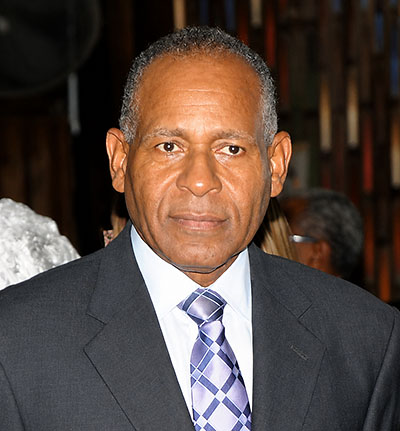
The Honourable
Patrick Augustus Mervyn Manning
BSc

Trinidad & Tobago
Patrick Augustus Mervyn Manning
August 17, 1946
-
July 2, 2016
Early Life and Family
Patrick Augustus Mervyn Manning was born on 17 August 1946 in San Fernando, Trinidad. He grew up in a modest and hardworking family that placed great importance on education, discipline, and service to the community. From an early age, he demonstrated a quiet confidence, a strong work ethic, and an interest in understanding the world around him. These qualities would shape his future career in both science and politics.
Manning received his early education at San Fernando Boys' Government School before attending Presentation College, one of Trinidad and Tobago's most respected secondary schools. During his school years, he developed a love for mathematics and science while also displaying leadership qualities among his peers. His teachers recognized his intelligence and determination, encouraging him to pursue higher education.
His upbringing in San Fernando gave him firsthand knowledge of the hopes and challenges facing ordinary Trinidadians. The experiences of growing up in a rapidly developing nation helped shape his belief that government should play a central role in creating opportunities for its citizens.
Education and Professional Career
After completing his secondary education, Manning attended The University of the West Indies where he studied geology. He graduated with a Bachelor of Science degree and began working as a geologist in Trinidad's growing energy sector.
His scientific background gave him a practical understanding of the country's rich petroleum and natural gas resources. This knowledge later proved valuable during his years as Prime Minister, particularly when making decisions involving the nation's energy industry and economic development.
Although he enjoyed his work as a geologist, Manning soon realized that his greatest passion was public service. He believed that he could make a broader impact by helping shape national policies rather than working solely within the private sector.
Entry Into Politics
Patrick Manning entered politics in 1971 when he successfully contested the San Fernando East constituency under the banner of the People's National Movement, commonly known as the PNM. Founded by Dr Eric Williams, the PNM had dominated Trinidad and Tobago's political landscape since independence.
Winning a parliamentary seat at a relatively young age marked the beginning of what would become one of the longest and most influential political careers in the nation's history.
As a Member of Parliament, Manning quickly gained a reputation as a thoughtful and disciplined representative. He devoted significant attention to the needs of his constituents while steadily building his experience in national affairs.
Throughout the 1970s and 1980s, he served in several ministerial positions, gaining expertise in government administration, planning, and economic management. His calm approach and analytical style distinguished him from many of his contemporaries.
Becoming Leader of the People's National Movement
The political landscape changed dramatically following the defeat of the PNM in the 1986 General Election. The party entered opposition for the first time since independence and faced the difficult task of rebuilding.
Following the death of Dr Eric Williams in 1981 and the leadership of George Chambers, the PNM sought a new direction. Patrick Manning emerged as one of the party's leading figures and was elected Political Leader in 1987.
Taking charge during one of the party's most challenging periods required resilience and determination. Manning worked tirelessly to reorganize the party, strengthen its grassroots support, and restore public confidence.
His leadership gradually revitalized the PNM and positioned it for a return to government.
First Term as Prime Minister
In December 1991, Patrick Manning led the PNM to victory in the General Election and became the fourth Prime Minister of Trinidad and Tobago.
His administration focused on economic reform during a period when the country was recovering from recession and financial difficulties. The government sought to encourage investment, improve public finances, and create conditions for sustainable economic growth.
Manning emphasized fiscal discipline while promoting private sector development. His government introduced policies aimed at increasing efficiency within the public service and expanding opportunities for local businesses.
Although his administration achieved several economic improvements, political challenges remained. In 1995, the General Election resulted in an evenly divided Parliament. Political negotiations eventually led to the formation of a government by the opposition, bringing Manning's first period as Prime Minister to an end.
Years in Opposition
Following the 1995 election, Manning returned to the role of Leader of the Opposition.
Rather than retreat from public life, he used the period to strengthen the PNM and refine his vision for Trinidad and Tobago's future. He remained active in Parliament, frequently debating issues relating to economic development, education, national security, and governance.
His years in opposition demonstrated his persistence and long term commitment to public service. Manning believed that political setbacks should serve as opportunities for reflection and renewal rather than reasons for withdrawal.
Return to Government
Patrick Manning returned as Prime Minister in December 2001 after another closely contested election. Fresh elections in 2002 produced a clear PNM victory, giving his administration a stronger parliamentary majority.
This second period in office became the defining chapter of his political career.
The country experienced substantial economic growth, largely driven by high global energy prices and increased investment in the natural gas sector. Manning sought to use these revenues to modernize Trinidad and Tobago through ambitious national development projects.
His administration invested heavily in roads, highways, hospitals, schools, housing, sporting facilities, and public buildings. Many of these projects transformed the country's physical landscape and were intended to support long term economic development.
Vision for National Development
One of Patrick Manning's defining characteristics was his willingness to think on a national scale. He believed Trinidad and Tobago should become a developed nation capable of competing internationally.
His government launched Vision 2020, an ambitious national development strategy designed to achieve developed country status through improvements in education, healthcare, infrastructure, technology, governance, and economic diversification.
Although not all of the plan's objectives were achieved, Vision 2020 influenced public policy discussions for many years and reflected Manning's belief that national progress required careful long term planning.
Education Reform
Education occupied a central place in Manning's vision for the country.
His government expanded educational opportunities at every level. Significant investments were made in constructing and upgrading schools while improving access to learning resources.
Perhaps the most widely recognized initiative was the Government Assistance for Tuition Expenses programme, commonly known as GATE. This programme enabled thousands of Trinidad and Tobago citizens to pursue university and technical education with government financial assistance.
The expansion of tertiary education allowed many young people from ordinary families to earn degrees and professional qualifications that might otherwise have remained beyond their reach.
Supporters regarded GATE as one of Manning's greatest achievements because it expanded educational opportunity across the nation.
Infrastructure and Urban Development
Patrick Manning strongly believed that modern infrastructure formed the foundation of economic growth.
His administration oversaw the construction of highways, government complexes, schools, health facilities, sporting venues, and housing developments throughout Trinidad and Tobago.
Major projects included the National Academy for the Performing Arts, the International Waterfront Centre, the Brian Lara Cricket Academy, and several urban renewal initiatives.
These projects generated employment while improving public facilities and enhancing the country's international image.
Some developments attracted criticism because of their costs, but supporters argued that such investments would benefit future generations through improved services and economic activity.
Regional and International Leadership
Manning played an important role beyond Trinidad and Tobago's borders.
He strongly supported Caribbean regional integration through the Caribbean Community, believing that cooperation among Caribbean nations would strengthen economic development and international influence.
He also advocated closer relations with Latin America and promoted Trinidad and Tobago as an important energy supplier within the region.
Internationally, he represented the country at numerous regional and global meetings where he spoke on issues including energy security, climate change, trade, and sustainable development.
His scientific background and practical knowledge of the energy sector earned him respect among international leaders.
Leadership Style
Patrick Manning was widely regarded as thoughtful, disciplined, and intellectually driven.
Unlike many politicians who relied primarily on emotion or charisma, Manning often focused on long term planning and detailed policy discussions. He preferred careful analysis before making important decisions and was known for speaking confidently about national development.
Supporters admired his vision, determination, and willingness to pursue ambitious goals. Critics sometimes viewed him as overly confident or distant. Nevertheless, few questioned his commitment to public service or his belief in Trinidad and Tobago's potential.
Throughout his career, he remained deeply committed to the PNM and its founding principles of national unity and development.
Retirement and Final Years
Following the 2010 General Election, the PNM lost office, bringing Manning's second period as Prime Minister to a close.
He continued serving as Member of Parliament for San Fernando East until announcing his retirement from active politics in 2015 after more than four decades of parliamentary service.
His retirement marked the end of one of the longest political careers in the history of Trinidad and Tobago. He remained respected as the country's longest serving Member of Parliament.
Patrick Manning passed away on 2 July 2016 at the age of 69 after battling illness.
His death prompted tributes from political leaders across the Caribbean, many of whom recognized his decades of dedication to public service and his significant contributions to national development.
Legacy
Patrick Manning remains one of the most consequential figures in the modern history of Trinidad and Tobago. Across more than forty years in public life, he helped shape the country's political institutions, educational opportunities, energy policies, and physical infrastructure.
His advocacy for expanded access to higher education transformed the lives of thousands of citizens. His emphasis on infrastructure reshaped many communities, while his Vision 2020 initiative demonstrated his belief that national progress required long term planning and ambitious thinking.
Like many influential leaders, his legacy continues to inspire both praise and debate. Admirers remember him as a visionary who sought to prepare Trinidad and Tobago for the future. Critics questioned aspects of his spending priorities and management style. Yet even those who disagreed with his policies generally acknowledged the scale of his ambition and his commitment to the country's development.
Today, Patrick Augustus Mervyn Manning is remembered as a statesman, strategist, and nation builder whose influence extended well beyond his years in office. His contributions to education, infrastructure, governance, and regional cooperation ensure that his place in the history of Trinidad and Tobago remains secure.
My Caribbean
Legends from Trinidad & Tobago
Caribbean Heritage
What major cultural celebration highlights Saint Lucia’s Creole heritage?
What Caribbean country is known as the "Spice Isle"?

Which two nations fought for control of St. Kitts in the 1600s?