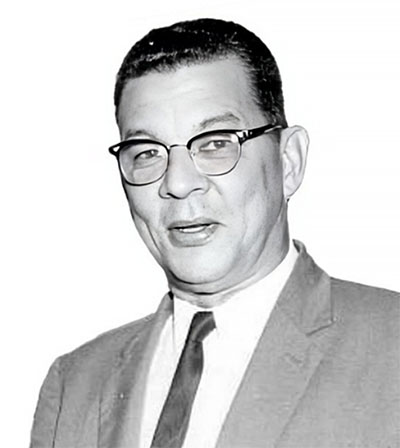

Sir Donald Burns Sangster stands among the most respected political figures in Jamaican history. Though his tenure as Prime Minister lasted only a few weeks, his contribution to the development of modern Jamaica spanned more than three decades. A skilled lawyer, financial administrator, parliamentarian, and statesman, Sangster played a vital role in shaping the economic and political foundations of independent Jamaica. His dedication to public service, integrity, and leadership earned him widespread admiration and a lasting place in the nation's history.
Donald Burns Sangster was born on October 26, 1911, in St. Elizabeth, Jamaica. He was the son of William B. Sangster, a land surveyor and planter, and Cassandra Sangster. Raised in a disciplined and hardworking environment, young Donald demonstrated academic promise and leadership qualities from an early age.
He attended the prestigious Munro College from 1921 to 1929. During his years at the institution, Sangster excelled not only academically but also in sports. He actively participated in cricket, football, athletics, boxing, and gymnastics. His love for sports continued well into adulthood, and he later captained the St. Elizabeth Parish cricket team.
After leaving school, Sangster pursued legal studies through apprenticeship and was admitted to practice as a solicitor in Jamaica in 1937. His legal training helped develop the analytical skills and attention to detail that would later define his political career.
Sangster entered public life at the remarkably young age of 21. In 1933, he won election to the St. Elizabeth Parochial Board, beginning a political journey that would last until his death. He quickly established a reputation as a diligent and capable public servant. By 1941, he had become Vice Chairman of the board, and in 1949 he was elected Chairman.
His first attempt to enter national politics came in 1944 during Jamaica's first general election under universal adult suffrage. Running as an independent candidate, he was unsuccessful. However, he remained committed to public service and eventually joined the Jamaica Labour Party (JLP), where he would become one of the party's most influential leaders.
In 1949, Sangster was elected to the Jamaican House of Representatives, representing South St. Elizabeth. This victory marked the beginning of his distinguished career in national government.
Throughout the 1950s and 1960s, Sangster steadily rose through the ranks of government. He served in several important ministerial positions, including Minister of Social Welfare and Labour and later Minister of Finance. His expertise in economics and public administration made him one of Jamaica's most respected policymakers.
Many contemporaries viewed Sangster as more of a technocrat than a traditional politician. He was known for his careful management of public finances, his deep understanding of economic issues, and his ability to work effectively behind the scenes. His calm and methodical style contrasted with the charismatic leadership of Jamaica's first Prime Minister, Sir Alexander Bustamante.
When Jamaica achieved independence in 1962, Sangster became the country's first Minister of Finance in the new independent government. His stewardship during this critical period helped establish financial stability and confidence in the young nation.
In March 1963, Sangster was appointed Deputy Prime Minister of Jamaica. His loyalty to Bustamante and his administrative competence made him a natural choice for the position. As Bustamante's health declined in the mid 1960s, Sangster increasingly assumed leadership responsibilities. He frequently served as Acting Prime Minister and became one of the most experienced figures in Jamaican government.
For several years, he effectively managed many of the affairs of government while Bustamante was ill. His steady leadership earned him respect both within Jamaica and throughout the Commonwealth. Some political observers referred to him as "The Quiet Gentleman" because of his modest personality, professionalism, and preference for substance over political theatrics.
Following the Jamaica Labour Party's victory in the 1967 general election, Donald Sangster succeeded Bustamante as Prime Minister on February 23, 1967. He became Jamaica's second Prime Minister and the first person to assume the office after independence other than Bustamante.
His appointment represented the culmination of more than thirty years of public service. Many Jamaicans expected that his extensive experience in government and finance would guide the country through a new phase of development and modernization.
Unfortunately, fate would intervene before those expectations could be realized.
Less than a month after taking office, Sangster suffered a serious neurological illness, later identified as a brain hemorrhage. His condition deteriorated rapidly, and he was flown to Montreal, Canada, for specialized medical treatment. Despite the efforts of doctors, his health continued to decline.
While in a coma, Sangster received one of the highest honors of the British Crown when he was knighted by Queen Elizabeth II. The honor recognized his distinguished service to Jamaica and the Commonwealth.
Sir Donald Burns Sangster died on April 11, 1967, in Montreal, Quebec, Canada, at the age of 55. He remains the only Prime Minister in Jamaican history to die while in office. His tenure lasted just 48 days, making it the shortest prime ministerial term in the country's history.
Following his death, Hugh Shearer was sworn in as Prime Minister, ensuring continuity in government during a period of national mourning.
Although his time as Prime Minister was brief, Sir Donald Sangster's impact on Jamaica was profound. His contributions as Minister of Finance, Deputy Prime Minister, and senior government official helped shape the economic and administrative structures of the newly independent nation. He was widely respected for his honesty, competence, and dedication to public service.
His legacy continues to be honored in several ways. Jamaica's principal international gateway, Sangster International Airport, bears his name. His image has also appeared on Jamaican currency, ensuring that future generations remember his contribution to national development.
Historians often regard Sangster as one of Jamaica's most capable administrators. Though overshadowed by more prominent political figures, his role in guiding Jamaica through the early years of independence was critical. His reputation as a hardworking, principled, and effective leader has endured long after his passing.
Sir Donald Burns Sangster's life was one of service, discipline, and dedication to country. From his beginnings in rural St. Elizabeth to the highest office in the land, he demonstrated a commitment to excellence and public duty. While his premiership was tragically cut short, his decades of work in government helped lay the foundation for modern Jamaica. Today, he is remembered not only as Jamaica's second Prime Minister but also as one of the architects of the nation's early success and stability.
Where did the musical instrument known as the Steel Pan originally originate from?

What major cultural celebration highlights Saint Lucia’s Creole heritage?
Which two nations fought for control of St. Kitts in the 1600s?