
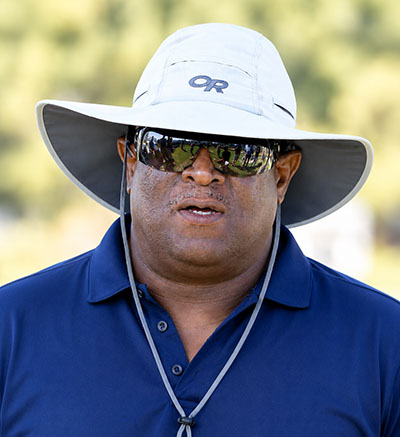
Stephen Everton Francis
1962
-
2026

Jamaica
Facebook
WhatsApp
Stephen Everton Francis
July 3, 1962
-
July 4, 2026
Stephen "Franno" Francis was a monumental figure in global track and field whose vision, discipline, and unwavering belief in human potential transformed Jamaica into the undisputed sprinting capital of the world.
For decades, the conventional wisdom in international athletics dictated that to achieve ultimate glory on the track, a Caribbean athlete had to migrate to the United States or Europe. Francis single handedly shattered that paradigm, proving that world records and Olympic gold medals could be forged entirely on Jamaican soil using local talent, local coaching, and local resources.
His passing marked the end of an era, but his profound impact on the sport remains permanently etched into the history of track and field.
The Foundation of a Brilliant Mind
Stephen Francis was born in Jamaica, growing up in an environment where sports were deeply woven into the cultural fabric, yet professional athletic development remained heavily reliant on external systems. From a young age, Francis demonstrated an exceptional intellect and an analytical approach to solving complex problems. He pursued higher education with a focus on finance and economics, eventually earning a Master of Business Administration degree.
His early career path was far removed from the dirt tracks and starting blocks of Kingston. Francis established himself as a highly successful executive in the financial sector, utilizing his sharp mathematical mind to navigate corporate investments and economic strategies. Despite his corporate success, his true passion lay in human biomechanics, physics, and the latent potential of Jamaican youth. He spent his spare time studying the intricacies of sprinting mechanics, analyzing video footage of international runners, and breaking down the precise physics of human velocity.
Shaking the Foundations of Track and Field
By the late 1990s, Francis reached a defining crossroads in his life. He recognized that while Jamaica possessed a wealth of raw, natural athletic talent, the nation was losing its best assets to foreign collegiate systems. Many young athletes who left for foreign universities struggled with the sudden cultural shift, suffered from over racing in collegiate circuits, or faded into obscurity before reaching their peak.
In 1999, Francis made the audacious decision to walk away from his lucrative and stable career in finance to dedicate his life entirely to coaching. He partnered with key figures, including his brother Paul Francis, Bruce James, and David Noel, to establish the Maximising Velocity and Power Track and Field Club, universally known as the MVP Track Club. Based at the University of Technology in Kingston, the club started with meager resources, lacking the state of the art facilities and massive budgets of American universities. What Francis lacked in infrastructure, he more than made up for with an uncompromising work ethic and a revolutionary training methodology.
Architect of the Sub Ten Second Revolution
The initial years of the MVP Track Club were defined by struggle and skepticism from the local athletic establishment. Many critics believed that a localized club could not compete with the powerhouse programs of the developed world. Francis silenced those critics through his work with a young, relatively unknown sprinter named Asafa Powell. Under the precise, data driven guidance of Francis, Powell developed a flawless, powerful stride that quickly caught the attention of the global track community.
In 2005, the sports world watched in awe as Asafa Powell broke the men's 100 meter world record in Athens, clocking a stunning time of 9.77 seconds. Powell would equal this mark twice more before lowering the world record to 9.74 seconds in 2007. This monumental achievement was a watershed moment for Jamaican track and field. It proved to the world, and more importantly to young Jamaican athletes, that the fastest man alive could be bred, trained, and sustained entirely at home under the tutelage of Stephen Francis. Powell became the pioneer of the sub ten second revolution, paving the way for a golden generation of Jamaican sprinters.
Forging the Rocket and the Pocket Rocket
While Powell opened the door, Francis continued to build an elite athletic empire that dominated the women's sprinting circuit for generations. His most enduring and decorated partnership was with a diminutive sprinter from Waterhouse named Shelly Ann Fraser Pryce. Standing at just over five feet tall, Fraser Pryce was overlooked by many mainstream coaches, but Francis recognized her explosive power and fierce competitive spirit.
At the 2008 Beijing Olympics, Francis shocked the world when Fraser Pryce captured the gold medal in the women's 100 meters, leading a historic sweep of the podium for Jamaica alongside teammates Sherone Simpson and Kerron Stewart. Francis guided Fraser Pryce to retain her Olympic 100 meter crown at the 2012 London Olympics, cementing her status as an all time great. Under his technical eye, she grew from an unheralded junior athlete into a multi time World Champion, renowned for her devastating starting execution and relentless drive.
The Double Olympic Glory of Elaine Thompson Herah
The assembly line of champions at the MVP Track Club showed no signs of slowing down as Francis continued to refine his coaching techniques. His next masterpiece came in the form of Elaine Thompson Herah, a talent whose collegiate career had been steady but not yet spectacular. Francis implemented a tailored training regimen that maximized her top end speed endurance, preparing her to challenge the highest echelons of global sprinting.
At the 2016 Rio Olympics, Thompson Herah achieved the rare and prestigious sprint double, capturing gold medals in both the 100 meters and 200 meters. The world witnessed the continuation of this dominance at the Tokyo Olympics, where she repeated the historic sprint double, setting an Olympic record of 10.61 seconds in the 100 meters. The precise periodization and physical conditioning designed by Francis allowed his athletes to peak at the exact moment required to achieve global immortality.
Expanding the Horizon Beyond the Short Sprints
While Francis is globally renowned for his mastery of the 100 meter and 200 meter sprints, his coaching prowess extended far beyond the short dash. He applied his analytical mind to the hurdle events and the quarter mile, proving that his training philosophies were universally applicable across various athletic disciplines.
Under his guidance, Melaine Walker transformed into a dominant force in the women's 400 meter hurdles, capturing the gold medal at the 2008 Beijing Olympics and setting a world championship record in 2009. Similarly, Brigitte Foster Hylton achieved ultimate glory in the 100 meter hurdles, winning a gold medal at the 2009 Berlin World Championships after years of persistent dedication. Francis also conditioned foundational relay assets such as Michael Frater and Nesta Carter, who formed the backbone of Jamaica's world record breaking 4x100 meter relay squads. In later years, his technical insights continued to guide elite talents like Shericka Jackson and Kishane Thompson, ensuring that the MVP Track Club remained at the pinnacle of international sport.
The Philosophy of Uncompromising Discipline
The hallmark of Stephen Francis's coaching style was his absolute, unyielding commitment to discipline, structure, and mental fortitude. Affectionately yet respectfully known as Franno, he was a coach who demanded total dedication from his athletes. He was famously blunt, never sugarcoating his assessments of an athlete's performance, fitness, or attitude. This raw honesty created an environment devoid of entitlement, where every accolade had to be earned through sweat on the training track.
Francis approached sprinting as a science, blending his knowledge of physics with an intimate understanding of individual human physiology. He was a master of identifying technical flaws that the untrained eye would miss, correcting an athlete's posture, foot strike, or hip alignment to shave off hundredths of a second. His training camps were legendary for their intensity, designed not only to build physical power but to forge an unbreakable psychological edge that allowed his athletes to thrive under the immense pressure of Olympic finals.
A National Treasure and Global Educator
The immense success of the MVP Track Club fundamentally altered the socioeconomic landscape of Jamaica. By keeping athletes at home, Francis helped create a thriving local sports economy that generated employment, attracted international sponsorships, and elevated the global profile of the country. His contributions to the nation were officially recognized in 2017 when the Government of Jamaica bestowed upon him the Order of Jamaica, one of the country's highest civilian honors, celebrating his outstanding service to track and field coaching.
Beyond the medals and titles, Francis was an educator who mentored a new generation of local coaches, ensuring that his knowledge would outlast his own career. He frequently challenged global sports governance, advocating for the rights and fair treatment of Caribbean athletes on the international circuit. He proved to the developing world that expensive facilities are secondary to superior intellect, strategic planning, and communal belief.
An Enduring Legacy of Speed
The passing of Stephen Francis at the age of 64 left the global sporting community in deep mourning, yet his legacy remains entirely secure. He took a small island nation with immense raw potential and built a self-sustaining athletic superpower that challenged and defeated the wealthiest nations on earth. The track may have fallen silent with his departure, but the echoes of his whistle, the power of his words, and the strides of his champions will reverberate through the stadiums of the world forever. Stephen Francis did not just coach runners, he designed icons and inspired an entire nation to believe that they could outrun the world.
My Caribbean
Cherished people from Jamaica


Caribbean Heritage
Which two nations fought for control of St. Kitts in the 1600s?

Where did the musical instrument known as the Steel Pan originally originate from?
Ackee and Saltfish is the national dish of which Caribbean country?