The Right Excellent
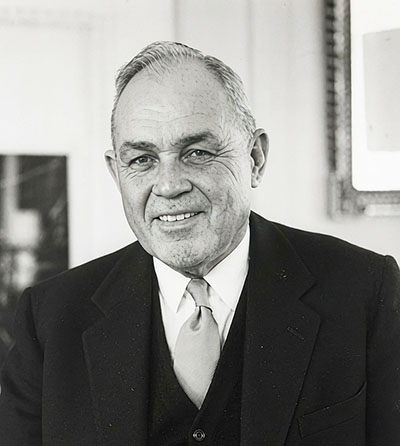
Roland Theodore Symonette
N.H.

Bahamas
Roland Theodore Symonette
December 16, 1898
-
March 13, 1980
Sir Roland Theodore Symonette remains one of the most influential, wealthy, and polarizing figures in the history of the Bahamas. Often affectionately or critically referred to as "Pop," Symonette rose from extremely humble beginnings on a remote family island to become an industrial titan and the first Premier of the Bahamas. His life spanned a period of profound transformation for the archipelago, charting its course from an isolated British colonial outpost to a thriving center for international tourism and finance. As the leader of the United Bahamian Party, his administration laid the economic infrastructure of the modern Bahamas, even as it faced immense social pressure from a rising majority population seeking racial and political equality.
Early Life and Humble Beginnings
Roland Theodore Symonette was born on December 16, 1898, in The Current, a small and isolated settlement located at the northwestern tip of the island of Eleuthera. He was the youngest of nine children born to Edwin Lofthouse Symonette, a local Methodist minister, and his wife, Lavania Alethia. Life in the Out Islands during the late 19th and early 20th centuries was difficult, defined by subsistence living and minimal resources. Tragedy struck the family early when Roland was still an infant; his mother passed away in Key West, Florida, leaving his father to raise the large family alone.
Because of the geographic isolation and economic constraints of the era, Symonette received a highly limited formal education. He attended the local public school in The Current, completing only six years of primary education, up to the sixth grade. Despite this barrier, Symonette possessed an innate intellect, a rigorous work ethic, and an insatiable desire to learn. He became a lifelong autodidact, teaching himself advanced concepts in business, mathematics, and engineering. Showing early leadership and capability, he even served briefly as an assistant schoolteacher at the age of 14, earning a meager income while seeking a broader path forward.
Entrepreneurial Rise and Prohibition Fortunes
Recognizing that teaching offered few financial prospects, the teenage Symonette ventured into business. He began by transporting agricultural produce from his father’s farm in Eleuthera to the capital city of Nassau on New Providence island. Seeking greater opportunities, he spent a brief period working in West Palm Beach and Riviera Beach, Florida, trying his hand at fishing and tomato farming. However, it was a major geopolitical shift in the United States that completely transformed Symonette's fortunes.
When the United States implemented Prohibition in 1920, banning the manufacture and sale of alcohol, the Bahamas became a strategic hub for bootlegging. Symonette seized the opportunity, using his maritime knowledge to run rum and whiskey across the Gulf Stream to the American mainland. The high-risk venture was immensely profitable. Unlike many who squandered their bootlegging wealth, Symonette strategically reinvested his earnings back into the legitimate Bahamian economy.
Over the next few decades, he built a massive commercial empire. He established a state-of-the-art shipyard, founded liquor stores, acquired vast tracts of prime real estate, and became a dominant contractor for public infrastructure. His companies built many of the roads, wharves, and harbors that modernized Nassau. Through these ventures, the boy with six years of schooling grew to become one of the wealthiest men of his generation, with a family fortune eventually estimated to be worth hundreds of millions of dollars.
Entry into Politics and the Bay Street Boys
With his vast commercial success, Symonette naturally pivoted into the political arena, which at the time was deeply intertwined with the colony's commercial interests. In 1925, at the age of 28, he successfully campaigned for a seat in the Bahamian House of Assembly. He went on to represent the Shirlea district, embarking on an unprecedented political career that would see him win successive elections without interruption for over half a century.
Symonette became a core leader of the merchant elite known colloquially as the "Bay Street Boys." This group consisted primarily of wealthy, white Bahamian businessmen who controlled both the commerce of Nassau’s main thoroughfare, Bay Street, and the political apparatus of the colony. In the 1950s, this faction formalized its power by establishing the United Bahamian Party (UBP), with Symonette at the helm. Under their stewardship, the government pursued aggressive pro-business policies, opening up the Bahamas to massive foreign investment, luxury tourism, and international banking, while legalizing casino gambling to attract wealthy American travelers.
First Premier of the Bahamas
As the Bahamas pushed for greater autonomy from Great Britain, the colonial constitution was revised to allow for internal self-government. Because the UBP held the majority in Parliament, Symonette, who had been serving as the de facto Head of Government since 1955, officially became the first Premier of the Bahama Islands on January 7, 1964. Recognizing his immense contributions to the colony's development and his unwavering loyalty to the British Crown, Queen Elizabeth II had previously knighted him in 1959.
As Premier, Sir Roland focused heavily on expanding the physical and economic infrastructure of the territory. He championed the modernization of Nassau’s harbor, the expansion of utility networks, and the construction of luxury resorts that solidified the country's reputation as a playground for the wealthy. Despite his alignment with the elite class, Sir Roland was also recognized for his extensive personal philanthropy. Remembering his own limited childhood opportunities, he quietly donated massive sums to local charities, built schools, and sponsored scholarships for young Bahamians seeking higher education abroad.
Political Transition and Later Life
While Sir Roland's economic policies brought prosperity to the business class, they also fueled deep social and racial resentment among the majority Black population, who felt systematically excluded from both economic wealth and political power. The opposition Progressive Liberal Party (PLP), led by a charismatic young lawyer named Lynden Pindling, mobilized this discontent, campaigning on a platform of racial equality and universal suffrage.
The watershed moment came in the general election of January 1967. The PLP achieved a historic victory, ushering in "Majority Rule" and bringing an end to the UBP's dominance. Sir Roland gracefully stepped down as Premier, handing over the leadership of the country to Lynden Pindling. Despite the shift in power, Sir Roland did not retreat from public service. He remained an active and influential member of the House of Assembly. When the UBP dissolved in the early 1971, he transitioned into the newly formed Free National Movement (FNM), continuing to serve as a voice for the opposition until his formal retirement from politics in 1977. His 52 consecutive years in Parliament stand as the longest record of legislative service in Bahamian history.
Personal Life, Death, and Enduring Legacy
Sir Roland's personal life was as dynamic as his career. He was married three times, first to Gertrude Nellie, with whom he had a son, Basil. His second marriage to Thelma Bell Clepper produced a son, Robert "Bobby" Symonette, who would later become a prominent politician and Speaker of the House of Assembly, and a daughter, Zelda. His third marriage was to Margaret Frances Phurlow, an American from Utah, with whom he had three children: Margaret, Roland, and Theodore. His descendants continued to form what locals called the "First Family" of Bahamian business and sports.
On March 13, 1980, Sir Roland Theodore Symonette passed away from cancer at his residence in Nassau at the age of 81. His passing marked the end of an era. Decades after his death, his legacy remains preserved in the fabric of the nation. In recognition of his foundational role in early governance, his portrait was selected to grace the Bahamian 50-dollar banknote. Additionally, on December 16, 2009, the Sir Roland Symonette Park was officially opened and dedicated in his beloved hometown of The Current, Eleuthera, ensuring that the boy who rose from its shores would never be forgotten.
My Caribbean
Legends from Bahamas
Caribbean Heritage
What Caribbean country is known as the "Spice Isle"?

Where did the musical instrument known as the Steel Pan originally originate from?

What major cultural celebration highlights Saint Lucia’s Creole heritage?